
Compliance support, with the evidence built in.
Awaab’s Law requires social landlords to act within prescribed timescales. We help you know sooner, act in time and keep a clear record of every step.
In force today. Wider from 30 November 2026.
Phase 1 covers damp and mould and emergency hazards. Phase 2 brings in excess cold, excess heat, falls, structural collapse, fire and explosions, electrical hazards and domestic hygiene.
Damp and mould, and emergency hazards
- Damp and mould
- Emergency hazards
Seven more hazard categories
- Excess cold
- Excess heat
- Falls
- Structural collapse
- Fire and explosions
- Electrical hazards
- Domestic hygiene
Source: GOV.UK, Awaab’s Law guidance for social landlords (timeframes for repairs, and phase 2).
Prescribed timescales, from day zero.
Emergency hazards: investigation and safety work within 24 hours. Timescales in working days; the investigation runs from awareness, the other steps from the end of the investigation.
Monitor the home. Record the issue. Record the response.
Government guidance recognises environmental monitoring as a way for social landlords to take proactive responsibility for the health of properties and tenants.
Know sooner
Sensors flag changing conditions, so awareness does not depend on a resident report.
Act in time
Alerts linked to the home and the case, so teams can see what is due and when.
One digital record
Readings, alerts, investigations, repairs and communication, together for every home.
Sensors indicate conditions. Whether a hazard exists, and how serious it is, is decided by an inspection. Our solutions support compliance; they do not replace your legal duties.
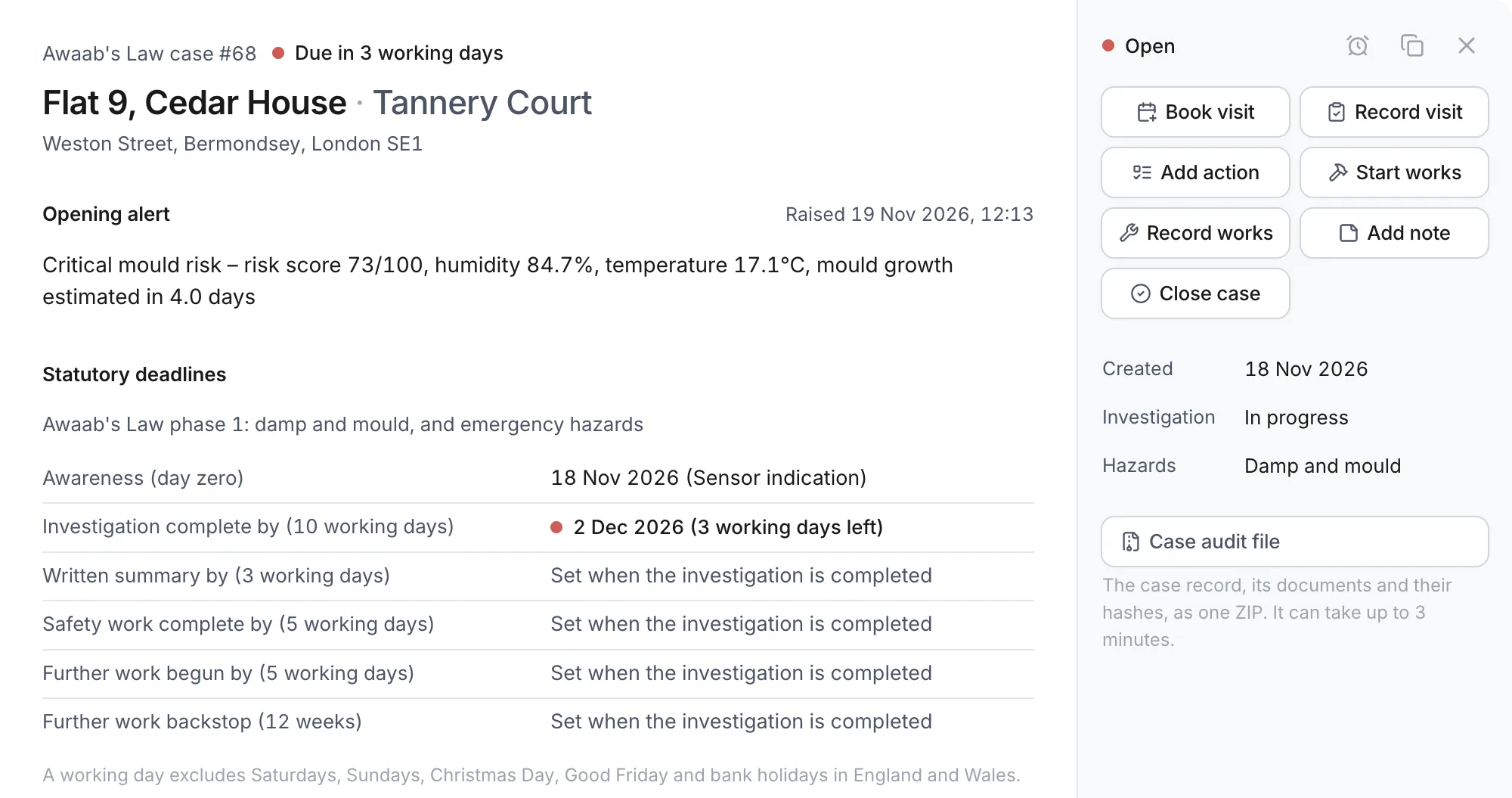
Know your homes. Know your evidence.
How sensors, alerts and reports work together to support Awaab’s Law compliance, shown on the platform with a demo organisation.
A proposition tailored for Wales.
Wales has its own rules. We work to them, rather than assuming that English Awaab’s Law obligations apply identically in Wales.
- Responding to hazards, from 1 April 2026. Under WHQS element 1c, social landlords investigate hazards with imminent harm within 24 hours and remedy them within a further 24; significant risks within 10 working days, then 5. If work takes longer, the tenant gets a written summary plan within 5 working days.
- WHQS 2023, by 2034. Homes free from damp, SAP 75 (EPC C) in the interim and SAP 92 (EPC A) as the standard, with a Target Energy Pathway for every home.
- Fit for human habitation. Under the Renting Homes (Wales) Act 2016, damp and mould growth is the first of the 29 matters and circumstances.
Sources: Welsh Government, WHQS 2023 and the WHQS addendum Responding to Hazards (in force 1 April 2026); fitness for human habitation guidance for landlords.
Talk to Matthew.
Matthew leads our Welsh housing association and local authority approach. Dated readings and alerts, and every investigation, summary plan and repair on one record, give you the evidence behind the quarterly WHQS return.
Let’s create healthier homes. Together.
Request an initial 30-minute executive conversation, see the platform, or discuss a pilot programme.